
Stepwise application of rotary evaporator in small-scale, pilot and large-scale experiments
In process research and development, rotary evaporator is a standard equipment in every laboratory. The requirements for rotary evaporator vary greatly in different experimental stages: small-scale experiments pursue rapid screening conditions, pilot experiments emphasize stable and reproducible processes, and large-scale experiments focus on efficiency and safety. Linbel Instrument has launched a rotary evaporator series with capacities ranging from 2L to 50L and larger 100L for these three stages.
Trial stage: Quickly explore and save samples
The small-scale experiment is usually completed on 2L or 5L rotary evaporator, with processing capacities ranging from tens of milliliters to 2L. The core goal of this stage is to explore suitable evaporation parameters with the minimum number of samples. For example, when concentrating an ethanol extract containing flavonoids, a small-scale experiment only requires bottling 300 ~ 500 milliliters to test the combined effects of different temperatures (40℃, 50℃, 60℃), vacuum degrees (0.08 ~ 0.095 MPa), and rotational speeds (60 ~ 100 rpm). The small-scale rotary evaporator temperature control accuracy of the Linbel Instrument reaches ±1.5℃, which is sufficient to meet the screening requirements. It is recommended to record the recovery rate of each batch of solvent and the state of concentrated extract during the pilot stage, which will be directly used for parameter setting during the pilot scale.
Pilot stage: Process validation, parameter locking
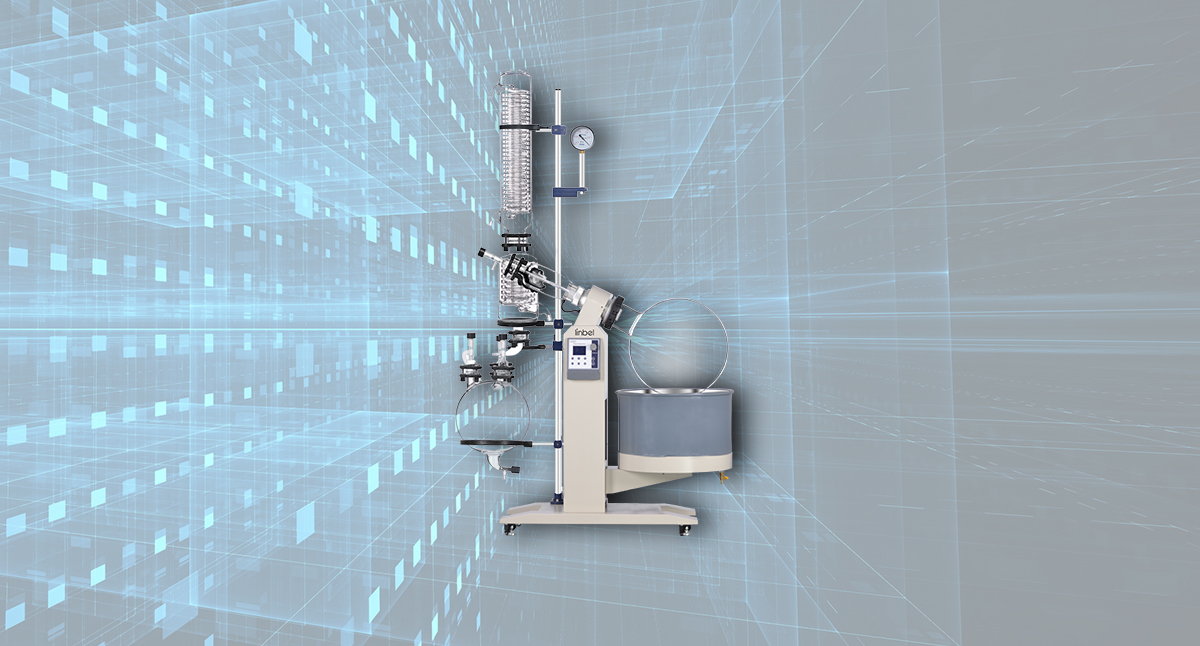
When the material in the pilot batch reaches 5 ~ 20L, it will be very time-consuming to continue adding materials repeatedly with the small-scale equipment. At this point, it is necessary to switch to the pilot level rotary evaporator (such as the Linbel 10L or 20L model). The key to the pilot test is to verify whether the parameters obtained from the small-scale test are still stable under large volume conditions. A common deviation in practical operation is that the concentration of ethanol at 40℃ and 0.095MPa was very smooth during the small-scale trial, but under the same conditions on a 20L rotary evaporator, the evaporation rate actually slowed down. The reason is that the liquid layer inside the large evaporator bottle is thicker, and it is necessary to increase the speed appropriately (from 80 to 100 revolutions per minute) or slightly raise the water bath temperature (from 40 to 45℃), while checking whether the condenser can match a larger steam flux. The Linbel 20L rotary evaporator adopts a vertical main cooling and auxiliary cooling triple reflux design, with a total condensing area of 1.19 square meters, and can maintain a stable recovery rate under moderate vacuum. During the pilot phase, 3-5 batches of repeated experiments were conducted to lock in the final process parameters for direct use in scaling up experiments.
Scaling up experiments: small-scale production, emphasizing safety and efficiency
The amplification experiment generally refers to a processing capacity of 50 liters or more, usually using a 50L or even 100L rotary evaporator, or entering a production type thin film evaporator. But many research and development laboratories do not have the conditions for large-scale equipment, so 50L rotary evaporator has become a common choice for scaling up experiments. At this stage, the material value is high and the batch quantity is large. The safety protection and continuous operation capability of the equipment are more important than parameter fine-tuning. The Linbel 50L rotary evaporator is equipped with overcurrent protection, over temperature protection, and anti dry burning protection, and the heating power of the water bath is correspondingly increased to ensure uniform heating. In practical operation, special attention should be paid to two points during the amplification stage: firstly, buffer bottles and condensation traps must be installed in the vacuum pipeline to prevent a large amount of steam from directly impacting the vacuum pump; The second is to promptly drain the accumulated water in the condenser after each operation to prevent pipeline blockage. In addition, it is recommended to control the feeding amount of the enlarged experiment between 1/3 and 1/2 of the volume of the evaporation bottle to reserve space for boiling.
Many processes fail from small-scale testing to large-scale testing because they skip levels without undergoing pilot testing. The rotary evaporator itself has excellent linear amplification characteristics - as long as the proportional relationship between vacuum degree, temperature, and speed remains unchanged, the concentration time can be roughly calculated based on the volume ratio. For example, the small-scale treatment of 500mL takes 15 minutes, while the pilot treatment of 10L (20 times the volume) takes about 300 minutes. This estimate has good reproducibility among products of different specifications in the edge labeling instrument. Therefore, it is recommended to establish a simple operation record card for each stage, including material name, solvent type, water bath temperature, vacuum degree, rotation speed, concentration time, and recovery rate, for direct reference in the next stage.
From small-scale rotary steaming for rapid screening, to pilot rotary steaming for process validation, and to large-scale rotary steaming for small-scale production, Linbel Instrument provides a product solution that covers the entire R&D chain. Users only need to choose the appropriate specifications based on their own material quantity and process requirements, and do a good job in data transmission between stages to obtain stable and controllable concentration effects.